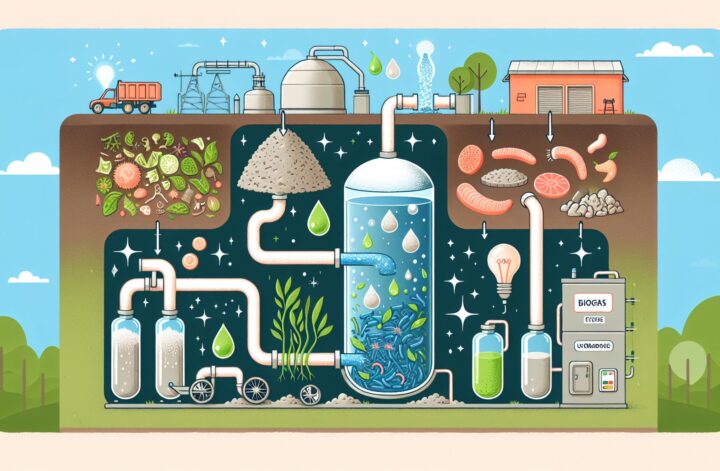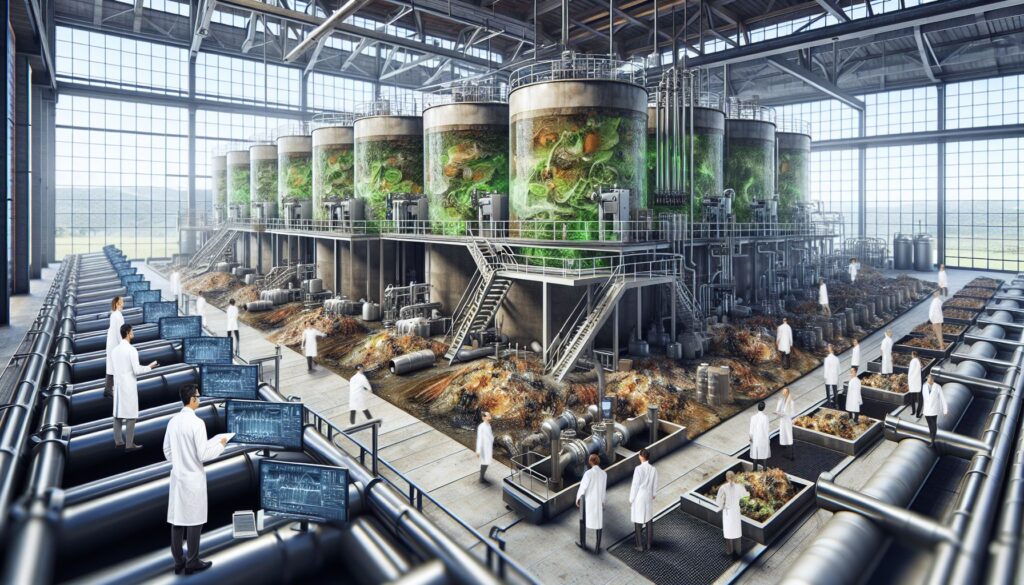
Solid waste management is rapidly becoming an issue of concern around the globe. The exponential increase in urbanization and population is leading to an escalation of garbage, a large percentage of which is organic waste. Traditional waste treatment processes are inefficient, time-consuming, and lack ecological friendliness that is demanded in this day and age. Thus, a more innovative and sustainable approach is needed to resolve this growing problem.
High-rate anaerobic digestion is emerging as an effective solution due to its efficiency, sustainability, and ability to convert waste into valuable green energy, thereby integrating waste management into the renewable energy sector. This article delves deep into what high-rate anaerobic digestion is and its role in organic waste treatment.
What is High-Rate Anaerobic Digestion?
High-rate anaerobic digestion is an advanced form of waste treatment technology that converts biomass into biogas. This process is done in a high-performance digester that allows for greater organic loading rates (OLR) and minimal hydraulic retention time (HRT). This means that the digester is able to process large volumes of organic waste in a short period, given its capability to handle high levels of volatile solids – a characteristic unique to high-rate digesters.
Traditional anaerobic digestion, although useful, can be slow and inefficient due to its need for a longer HRT and lower OLR. Additionally, it often requires large land space, may add to greenhouse gas emission and tends to leave a significant amount of residual sludge that needs further treatment. High-rate digestion is the “next-level” and accelerates the process, achieving comparable results in less than half the time and space (source: “Anaerobic Digestion: Developments and Innovations”).
How Does High-Rate Anaerobic Digestion Work?
High-rate anaerobic digestion integrates the traditional four-step process — hydrolysis, acidogenesis, acetogenesis, and methanogenesis — into a singular, continuous mechanism. Here is a brief breakdown of these steps:
– Hydrolysis: Large organic molecules are broken down into smaller soluble molecules.
– Acidogenesis: Soluble organic molecules are further converted into volatile fatty acids and alcohols.
– Acetogenesis: The products of acidogenesis are converted into acetate, hydrogen, and CO2.
– Methanogenesis: Acetate and hydrogen are finally converted into methane.
These steps occur almost simultaneously, enabling the high rates of digestion (source: “High-rate Anaerobic Digestion for Wastewater Treatment”).
The Advantages of High-Rate Anaerobic Digestion
- Production of Biogas: High-rate anaerobic digestion not only effectively disposes of waste but also converts it into biogas, an invaluable source of renewable energy.
- Reduces Waste Volume: The process significantly reduces the volume of waste that enters the system, resulting in lesser residual waste.
- Feasibility: High-rate digesters are small and compact, making them suitable for even densely populated urban settings.
- Reduce Greenhouse Gas Emission: The scrubbing mechanisms minimize the amount of methane released, thereby helping curb greenhouse gas emissions.
- Cost-Effective: High-rate anaerobic digestion cuts down the costs associated with waste management and energy production since it amalgamates both processes.
The Role of High-Rate Anaerobic Digestion in Organic Waste Treatment
High-rate anaerobic digestion plays a pivotal role in waste management by integrating organic waste treatment into renewable energy production. The organic waste, which otherwise would contribute to land and water pollution, is instead transformed into useful products like biogas and biosolids. The former serves as a green energy source while the latter may be used as a soil conditioner. The versatility of the process makes it suitable for treating various kinds of organic waste, including agricultural residue, food waste, sewage sludge, and animal waste.
Towards a Sustainable Future
High-rate anaerobic digestion offers a transformative solution to waste management by prioritizing sustainability, efficiency, and renewable energy. As our world grapples with the escalating environmental issues, this advanced technology provides an ecological and efficient waste treatment process that could effectively contribute to the creation of a more sustainable and resilient future.
Sources
- Younesi, H., Najafpour, G., & Mohamed, A. (2005). Ethanolic fermentation in an anaerobic batch reactor using Saccharomyces cervisiae. Process Biochemistry, 40(8), 2895-2899.
- Ferry, J. G. (1999). Enzymology of one-carbon metabolism in methanogenic pathways. FEMS Microbiology Reviews, 23(1), 13-38.
- Feng, Y., Zhang, Y., Quan, X., & Chen, S. (2014). Enhanced anaerobic digestion of waste activated sludge digestion by the addition of zero valent iron. Water research, 52, 242-250.