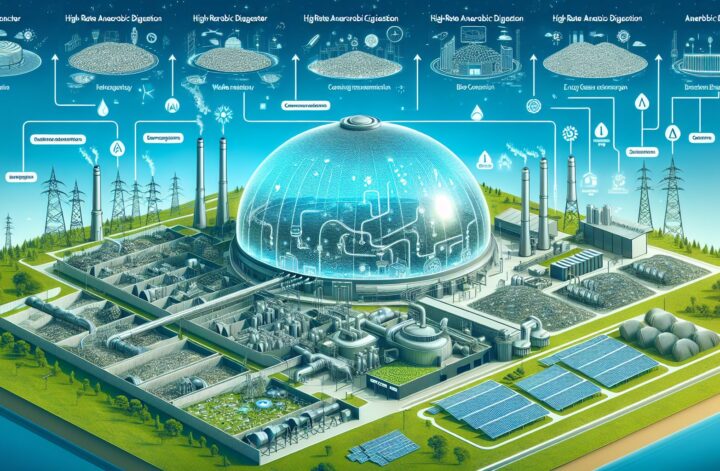
The continuous surge in the global population and industrial activities have led to escalating concerns about the sustainable management of waste while ensuring an adequate and renewable energy supply. These challenges have sparked significant interest in a green energy resource, known as Biogas. Although biogas predominantly constitutes methane and carbon dioxide, it serves as an environment-friendly and sustainable substitute for non-renewable fuels. Hence, it is crucial to understand the process of biogas production and its implications for energy sustainability and waste management.
What is Biogas Production?
Biogas production refers to the process of bio degradation or breakdown of organic material in the absence of oxygen, primarily through the anaerobic digestion process. The organic material or substrate is subjected to different bacteria, converting the substrate through multiple stages into a gas— biogas[^1^].
The anaerobic digestion comprises four steps: hydrolysis, acidogenesis, acetogenesis, and methanogenesis.
-
Hydrolysis: In this phase, organic polymers like fats, proteins, and carbohydrates are broken into smaller molecules: amino acids, sugars, etc., by extracellular enzymes.
-
Acidogenesis: Consequent to hydrolysis, the resultant molecules are then fermented into volatile fatty acids, alcohols, ammonia, CO2, hydrogen, and sulphates.
-
Acetogenesis: In the third phase, these products are further fermented into acetic acid, carbon dioxide, and hydrogen.
-
Methanogenesis: Finally, archaea bacteria convert these elements into methane, carbon dioxide, and water.
Factors Influencing Biogas Production
Several factors influence the efficiency and quantity of biogas production, including the nature of the substrate, temperature, pH, Hydraulic Retention Time (HRT), and Organic Loading Rate (OLR).
The type and concentration of organic substrates significantly affect the amount of methane produced, with substrates high in lignin generally resulting in lesser methane yield.
The optimal pH range for anaerobic digestion lies between 6.5 and 8.0, serving the different types of bacteria during each phase of biogas production.
The temperatures, too, have a vital role in maintaining stable digestion, with two prime ranges, being mesophilic (25-40°C) and thermophilic (50-60°C).
HRT or the time required by the system to process all the feedstock and OLR, determines the volume of organic material that the system can process per unit volume per day. These factors require careful monitoring to prevent overloading and inhibition of biogas production.
Biogas Upgrading and Use
Biogas post-production undergoes the process of upgrading, where it is purified and conditioned to increase its methane concentration, thus enhancing its energy content. Biogas scrubbing is involved to remove components like hydrogen sulfide, water vapour, siloxanes, and CO2 primarily[^2^].
The purified and upgraded biogas, also called biomethane, can be used for direct combustion in Combined Heat and Power (CHP) production units for the generation of heat and electricity.
Advantages of Biogas Production
Biogas production’s key advantage lies in its sustainable and renewable nature, providing an innovative solution to dual crises of waste management and energy scarcity. Additionally, it aids in reducing greenhouse gas emissions as it utilizes methane – a potent greenhouse gas – for energy. It also aids in sludge stabilization, a key issue in wastewater treatment plants. The end product of biogas production, or digestate, can be utilized as a biofertilizer, thus, promoting a circular economy.
The Future of Biogas
The future of biogas production looks promising, with advancements in anaerobic digester designs and the rising popularity of co-digestion, or the simultaneous digestion of multiple substrates to boost gas production. Further research on anaerobic digestion microbiology and syntrophic relationships can lead to better understanding and efficient utilization of this renewable energy source[^3^].
Therefore, the benefits of biogas production reflect its potential to transform waste management strategies and promote the usage of renewable energy. Let’s contribute our bit towards a sustainable environment through biogas utilization.
References
[^1^]: Speece, R. E. (1996). Anaerobic biotechnology and odor/corrosion control for municipalities and industries. Archae Press.
[^2^]: Krich, K., Augenstein, D., Batmale, J.P, Benemann, J., Rutledge, B., and Salour, D.(2005). Biomethane from dairy waste: A source book for the production and use of renewable natural gas in California. Western United Dairymen (WUD).
[^3^]: Rivard, C.J., and Grotenhuis, T. (1996). Pilot-scale high solids thermophilic anaerobic digestion of municipal solid waste with yard waste. Biotechnology Letters, 18(7), 783-788.