The world is currently facing a significant challenge: how to balance the need for energy with the adverse impacts of the existing energy production methods on the environment. As a result, there has been growing interest in the use and development of renewable energy sources, such as biogas, which can provide sustainable and eco-friendly energy solutions. One promising approach to biogas production is high-rate anaerobic digestion, which holds substantial potential in waste treatment and energy recovery. We will explore this fascinating subject in-depth in this article.
Anaerobic digestion, a complex series of processes involving different groups of microorganisms, transforms organic waste into biogas—an energy-rich mixture of methane, carbon dioxide, and trace elements. High-rate anaerobic digestion takes the concept a step further, improving efficiency and increasing the speed of these processes[^1^].
Understanding High-Rate Anaerobic Digestion
High-rate anaerobic digestion refers to a group of technologies designed to achieve a higher loading rate and improved biogas yield while using less space than conventional anaerobic digesters[^2^]. These technologies can enhance the treatment efficiency and shorten the hydraulic retention time (HRT), making the process more economically viable.
The essence of high-rate anaerobic digestion is to maximize the conversion of organic matter into biogas through the optimization of syntrophic relationships among different types of microorganisms. The organic loading rate (OLR) forms a critical part of the process optimization. The OLR determines the amount of organic matter that can be processed in the digester within a specified time, directly affecting the biogas yield and the stability of the digester[^3^].
The Process Involved
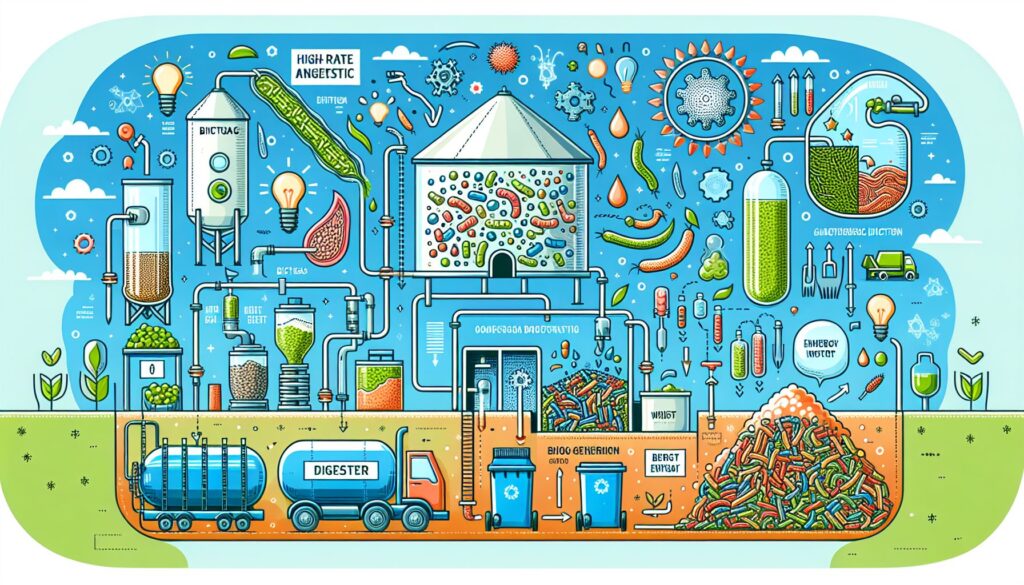
High-rate anaerobic digestion involves four primary steps: hydrolysis, acidogenesis, acetogenesis, and methanogenesis. Each phase is marked by different microbial processes.
- Hydrolysis: This initial phase involves the breaking down of complex organic matter into simpler soluble compounds, primarily carried out by hydrolytic bacteria.
- Acidogenesis: Next, acid-forming bacteria convert the soluble compounds into volatile fatty acids and alcohols.
- Acetogenesis: During this phase, secondary fermenters transform the resulting products into acetic acid, hydrogen, and carbon dioxide.
- Methanogenesis: Finally, methane-forming archaea generate biogas from acetic acid, hydrogen, and carbon dioxide[^3^].
While these steps also occur in traditional anaerobic digestion, high-rate digesters are specifically designed to ensure that each stage happens as efficiently as possible. All four phases should be well-balanced to avoid inhibition caused by rapid production or accumulation of intermediary products, such as volatile fatty acids or ammonia, which can lead to digester instability.
Advantages of High-Rate Anaerobic Digestion
High-rate anaerobic digestion offers several advantages over traditional digestion methods:
- Increased Biogas Production: High-rate systems can produce more biogas per volume of substrate, enhancing overall energy recovery.
- Reduced Retention Time: These systems can process waste materials more quickly, reducing the hydraulic and solid retention times.
- Compact Design: High-rate digesters are often more compact than traditional digesters, reducing land area requirements.
- Efficient Waste Treatment: These systems can handle high-strength wastes, such as food waste or wastewater sludge, offering efficient waste treatment and resource recovery.
Challenges and Potential Solutions
Despite its many advantages, like any technology, high-rate anaerobic digestion is not without its challenges. Microbial imbalances or the accumulation of inhibitory compounds can disrupt the digestion process, leading to reduced biogas production or even system failure[^2^].
Fortunately, advancements in digester design and process monitoring are helping address these challenges. Carefully controlling the environmental conditions within the digester can optimize the activity of the microbes involved in the process. Incorporating feedback systems to monitor and adjust digester conditions can significantly enhance system stability and performance.
Similarly, advances in additive technology, such as trace element supplementation, can boost microbial activity and counteract potential inhibitors. By enhancing the availability of essential nutrients, these additives can improve the overall wellbeing of the microbes and maintain the stability of the digestion process.
The Role in Environmental Sustainability
High-rate anaerobic digestion plays an essential role in driving sustainability by reducing greenhouse gas emissions, managing waste, and offering an alternative source of renewable energy[^2^].
Many types of organic wastes, including agricultural residues, food waste, and wastewater sludge, can be processed in a high-rate anaerobic digester to generate biogas, reducing waste volumes and converting them into valuable resources. The biogas produced can further be used to generate electricity and heat through combined heat and power systems, significantly reducing our dependence on fossil fuels and contributing to greenhouse gas reduction efforts.
Conclusion
High-rate anaerobic digestion proves a promising technology, harnessing the power of microorganisms to transform waste into valuable resources. Though it faces some challenges, continuous advancements in digester design, process monitoring, and additive technology promise to spur growth. By understanding the fundamental principles and the broader implications of high-rate anaerobic digestion, we position ourselves closer to a future where clean, renewable energy is the norm.
[^1^]: Kraemer, James T., and Defeng Xing. “High-rate anaerobic reactors for wastewater treatment: A review.” Biotechnology Advances 34, no. 5 (2016): 815-831.
[^2^]: Van Lier, Jules B. “High-rate anaerobic wastewater treatment: diversifying from end-of-the-pipe treatment to resource-oriented conversion techniques.” Water Science and Technology 57, no. 8 (2008): 1137-1148.
[^3^]: Khanal, Samir Kumar. “Anaerobic biotechnology for bioenergy production.” Hoboken, USA: John Wiley & Sons, Inc., 2008.