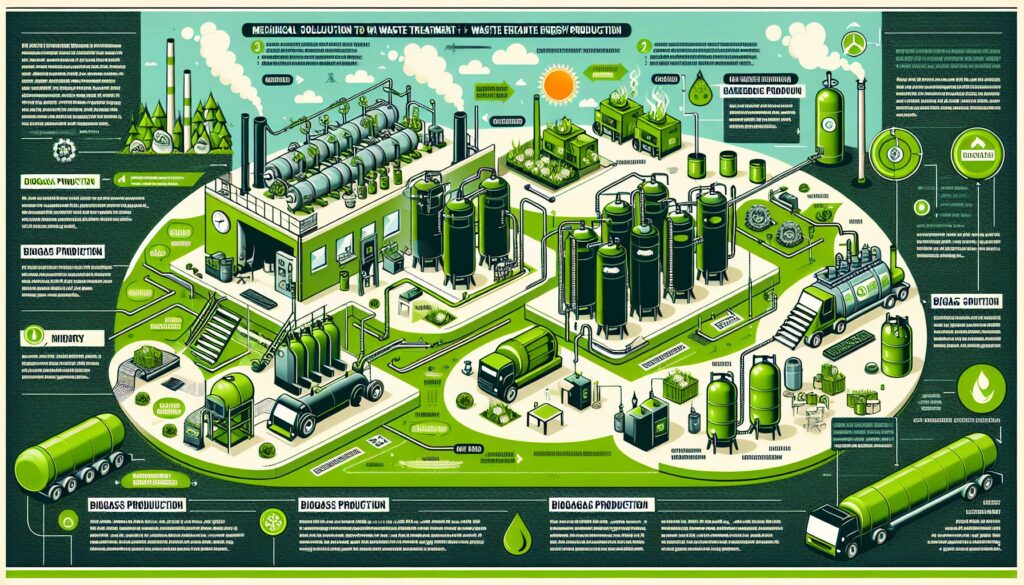
In our quest for sustainable living, the efficient utilization of renewable energy resources plays a vital role. Among these sources, biogas production stands as one of the most practical and promising alternatives to conventional energy supplies. Biogas, primarily composed of methane and carbon dioxide, is a renewable source that can be used for heating purposes, as a fuel in gas engines or upgraded to natural gas-quality biomethane. This green energy solution helps in waste treatment, reducing greenhouse gas emissions, and providing clean energy.
Understanding Biogas Production
Biogas originates from the process of anaerobic digestion, an intricate process of decomposition and fermentation that occurs when organic matter is broken down in an oxygen-less environment. Sources for this organic matter can range from agricultural waste, livestock manure, sewage sludge, to organic waste from households or food processing industries[^1^].
This process is categorized into four major stages: Hydrolysis, Acidogenesis, Acetogenesis and Methanogenesis.
-
Hydrolysis: The organic material, particularly large polysaccharides, proteins, and lipids, is broken down into simpler sugars, amino acids, and fatty acids respectively.
-
Acidogenesis: In this stage, microorganisms transform the by-products of hydrolysis into volatile fatty acids along with other compounds including ammonia, carbon dioxide, and hydrogen sulfide.
-
Acetogenesis: The volatile fatty acids are subsequently converted into acetic acid, hydrogen, and carbon dioxide.
-
Methanogenesis: The methane-producing bacteria, methanogens, metabolize the products of the previous steps, particularly acetic acid, hydrogen, and carbon dioxide, to produce methane biogas^2^.

Factors Affecting Biogas Production
Like any other microbiological procedure, the efficiency of anaerobic digestion and biogas yield depends largely on several process parameters. These include temperature, retention time, organic loading rate (OLR), pH, and the nutrient balance. The operation temperature of an Anaerobic Digester (AD) is typically either mesophilic (20°C to 40°C) or thermophilic (45°C to 60°C). Higher temperatures lead to faster decomposition rates but also demand more energy to maintain.
The hydraulic retention time (HRT) and solid retention time (SRT) denote the average time the liquid and solid substrates respectively spend in the digester, playing a crucial role in determining AD’s efficacy. A longer retention time typically results in a higher rate of digestion, and thus, more biogas production.
Organic loading rate (OLR) is a pivotal factor that refers to the amount of volatile solids (VS) added per day per volume of the digest. A higher OLR leads to a higher biogas production rate until a certain threshold, beyond which the process could be detrimentally affected and lead to system disruptions[^3^].
Inhibition of Anaerobic Digestion
Though anaerobic digestion of organic waste is a practical and environmentally friendly solution, several inhibitory factors can reduce the efficiency of this process. Among them, ammonia toxicity and sulfide toxicity are the most significant. High concentrations of ammonia in the digester can lead to a decline in the activity of methanogens, whereas excessive sulfide levels can create an inhibitory effect on methane production. Proper management and control of these factors are key to maintaining the productive performance of an AD system[^4^].
Additionally, trace element supplementation can avoid nutritional deficiencies, maintaining active microbial population and optimizing the digestion process[^5^].
Methane Capture and Utilization
Methane capture involves trapping the produced methane, preventing it from escaping into the atmosphere. As methane is a potent greenhouse gas, efficient capture and utilization of methane can significantly contribute to reducing greenhouse gas emissions.
After capturing, the biogas can now be used. However, it typically contains impurities that need to be removed, a process known as biogas upgrading. After upgrading, one could use this biogas in various applications such as captive power generation, heating, and even as vehicular fuel. In some cases, biogas is processed to combined heat and power (CHP), a process that allows the simultaneous generation of electricity and useful heat[^3^].
Wrapping Up
Biogas production offers immense potential as an effective technique for organic waste management while simultaneously delivering a renewable source of energy. Tuning the process parameters wisely, mitigating the inhibitory factors, and successfully capturing and upgrading the biogas can tremendously enhance its commercial effectiveness and environmental friendliness.
[^1^]: Environmental Protection Agency, US Government
[^3^]: Biogas Institute of Ministry of Agriculture, China
[^4^]: National Center for Biotechnology Information
[^5^]: Springer Link