The world today stands at the brink of an energy crisis, the likes of which, has never been faced by humankind before. With every passing day, the list of countries depending on non-renewable energy sources such as coal and crude oil is getting smaller and smaller. However, a big question lies in front of us – what will replace these sources? For this, let’s delve into the world of Biogas Production.
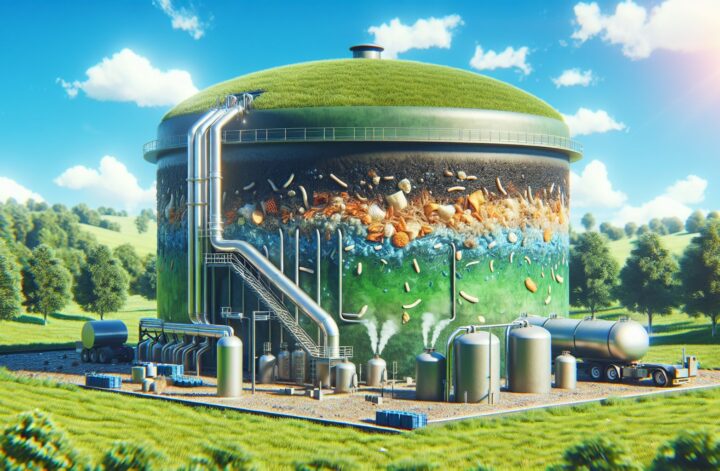
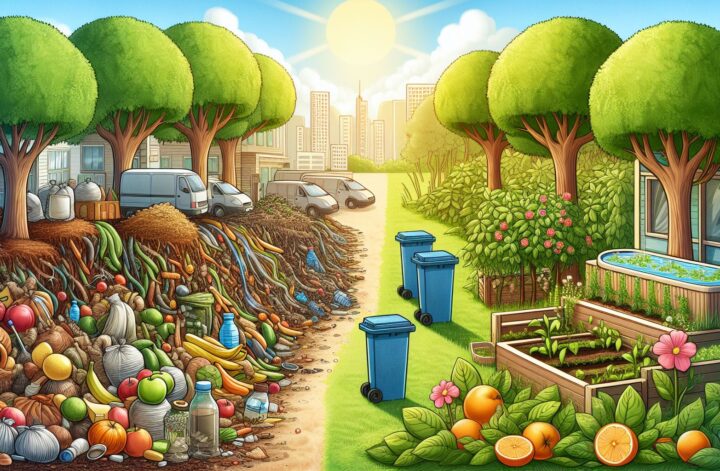
Simply put, biogas is produced from raw materials such as agricultural waste, waste from food production, manure, municipal waste, plant material, sewage, green waste, or food waste. The process of biogas production is often called ‘anaerobic digestion’ because the process requires an environment that lacks oxygen.
The Process of Biogas Production
The anaerobic digestion process is a series of biological processes in which microorganisms break down biodegradable material in the absence of oxygen. The process is used for industrial or domestic purposes to manage waste or to produce fuels. However, the precise nature and steps involved may vary, but let’s take a look at the overarching steps:
-
Hydrolysis: In this initial step, complex organic matter like carbohydrates, protein, and fats are converted into simpler forms of sugars, amino acids, and fatty acids respectively. This is done by the hydrolytic bacteria.
-
Acidogenesis: The products of hydrolysis are further converted into methanol, carbon dioxide, hydrogen, and volatile fatty acids by the acidogenic bacteria.
-
Acetogenesis: This step transforms volatile fatty acids into acetic acid, also producing carbon dioxide and hydrogen in the process.
-
Methanogenesis: To get biogas, methanogenic bacteria convert the acetic acid into methane and carbon dioxide[^1^].

Fig 1: Anaerobic Digestion[^4^].
Advantages of Biogas
From being cost-effective to an unlimited source of energy, here are some advantages of Biogas:
-
Renewable Source of Energy: The fact that biogas consists of waste material such as animal manure, dead plants, fruit and vegetable peels, leftovers of food, and much more, makes for an unlimited source of biogas generation.
-
Cost-Effective: Biogas production is economical since it offers a great return on investment. The raw material and technology are inexpensive.
-
Carbon Neutral: Biogas production, being a natural process, is kind to Mother Nature. The methane generated captures the carbon content of the waste, becoming carbon-dioxide when burnt – this carbon dioxide is then readily absorbed by plants, hence creating a perfect cycle.
-
Waste Management: By utilizing animal and plant waste, we are not only providing a solution for waste management but also deriving benefit out of them.
Challenges in Biogas Production
Despite many advantages, a few challenges are indeed there when it comes to biogas production. For instance, pre-processing of feedstock, technological advancement, setting specific standards, etc, need addressing to ensure a flawless production.
Looking Forward
Although we have barely scratched the surface in understanding the potential that lies in Biogas production, the implications are clear. With advancements in technology, it won’t be surprising to see the increased adoption and development of infrastructure to fully tap into the power that Biogas holds. Not just as a cleaner alternative to traditional energy sources, but as a viable option for waste management and a step forward in creating sustainable and circular economies.
With continuous research and constant development making biogas production more efficient, the future is certainly bright for this renewable energy. By adopting such sustainable technology, we can aim for a waste-free, pollution-free, and more sustainable Earth.
In conclusion, as per the current state of knowledge and advancement, biogas is an underrated renewable energy source. Given the ever-increasing global energy demands and the necessity to look for abundant, cheap, and renewable sources of energy, there is a definite need for extensive research and utilize this vast untapped potential of biogas production to its fullest[^2^] [^3^].
Endnotes:
[^1^]: Brunner, P. H., & Rechberger, H. (2015). Waste to energy—key element for sustainable waste management. Waste Management, 37, 3-12.
[^2^]: Pagliano, P., & Menale, C. (2013). A methodology for assessing the sustainability of hydrogen production from solid waste. Sustainability, 5(11), 4646-4668.
[^3^]: Lim, S. N., & Rahman, S. A. A. S. (2014). Renewable bio-gasoline production via co-processing of swine manure and crude glycerol in supercritical water and a side reactor. Energy Conversion and Management, 80, 287-296.
[^4^]: Image source: Global Syn-Turf
About the Author
The author is an accomplished writer and researcher with several dotingly produced blog articles focused on renewable energy and waste management.