
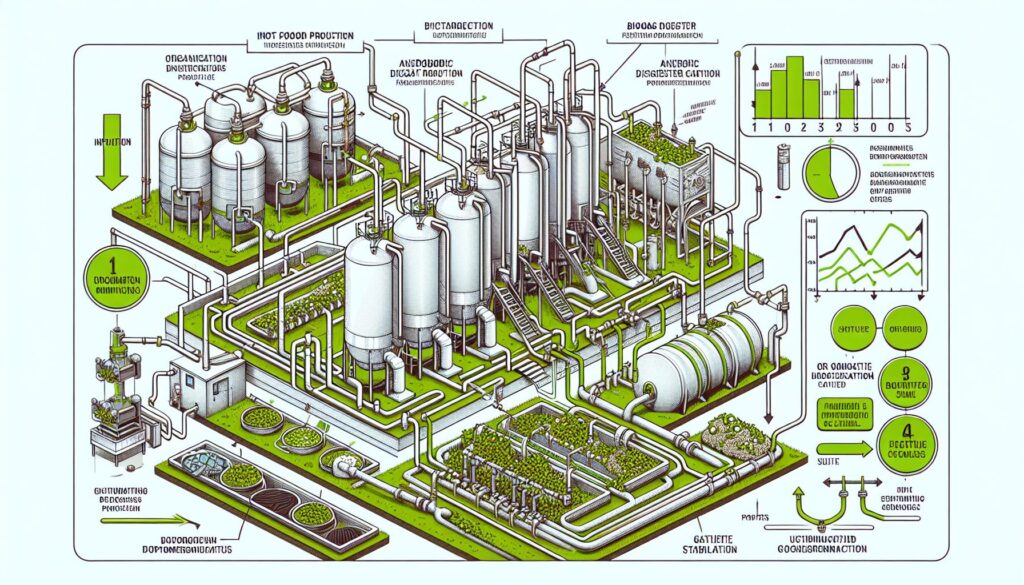
In recent times, the world has increasingly focused on methods of producing renewable and sustainable sources of energy. Greenhouse gas (GHG) emissions and nuclear wastes have raised urgent concerns for institutions worldwide. The demand for cleaner and renewable sources of energy has soared more than ever before. One of these renewable sources of energy that has shown promise is biogas.
Biogas production offers several advantages: supplying renewable energy (methane), nutrient recycling (nitrates and phosphates), organic waste management, and reduction of greenhouse gas emissions. These advantages can be reaped through optimized biogas production, efficient methane capture, and stable sludge stabilization.
This article will explore how biogas production can be optimized through efficient methane capture and sludge stabilization processes.
What is Biogas?
In its simplest form, biogas is a type of biofuel that is naturally produced from the decomposition of organic waste. The organic materials are broken down in an oxygen-free environment, a process called anaerobic digestion. The end-products of anaerobic digestion are biogas and digestate. The biogas is chiefly composed of methane (CH4), carbon dioxide (CO2), and small amounts of other gases.
Rapid industrialization and urbanization worldwide have resulted in a significant increase in organic wastes. Consequently, various strategies have been employed for the handling and disposal of these waste materials[^1^]. One of these strategies is biogas production.
Methane Capture and Biogas Production
Biogas contains about 50-75% methane, a potent greenhouse gas when not captured. Methane is a significant contributor to climate change, having 25 times more warming potential than carbon dioxide over a hundred-year period[^2^]. Hence, capturing this methane is pivotal to global climate change management and drastically reducing global warming potentials.
When organic wastes are subjected to anaerobic digestion, methane gas is produced, which can be captured and harnessed for practical use. The captured methane is a versatile gas with several uses. It can be processed into renewable natural gas and used for heating, electricity generation, and automobile fuel.
Furthermore, the carbon dioxide component of biogas can also be processed and utilized beneficially. It can be used for crop production in greenhouses, the beverage industry, and even to enhance oil recovery.
By capturing methane and utilizing it rightly, the organic waste generated worldwide can be turned into a valuable resource while simultaneously protecting our planet’s health against further soil, water, and air pollution.
Sludge Stabilization and Biogas Production
One of the major organic waste inputs for biogas production is the wastewater sludge obtained from sewage treatment plants. The sludge stabilization process is a key component of the anaerobic digestion process.
Sludge stabilization aims to reduce the biological and chemical activity within the organic matter to the barest minimum. This is typically achieved by transforming the volatile solids in the sludge into stable materials and biogas. It primarily involves two steps: the breakdown (hydrolysis) of the complex compounds into simpler ones and the conversion of these simpler compounds into biogas through further biological treatments[^3^].
Stabilized sludge offers immense advantages, including reduced sludge volume, decreased production of offensive odor, minimized pathogens, and lower potential for putrefaction. More so, the stabilized sludge, often referred to as biosolids, can be safely reused in agriculture after undergoing further treatments to remove potential quarantine pests and decrease heavy metal concentrations.
Conclusion
Renewable energy represents the future of global power supply and sustainability. As the demand for cleaner and renewable energy sources grows, optimizing sustainable energy processes such as biogas production becomes imperative. Eco-efficient production of biogas through effective methane capture and sludge stabilization offers a promising solution to the global crisis of energy production and environmental degradation.
By improving our biogas production processes, we can contribute to drastically reducing GHG emissions while generating renewable energy from waste materials that would otherwise contribute to pollution in our environment. Therefore, the optimized production of biogas represents a sustainable approach to waste management and renewable energy production.
[^1^]: Appels, L., Baeyens, J., Degrève, J., & Dewil, R. (2008). Principles and potential of the anaerobic digestion of waste-activated sludge. Progress in Energy and Combustion Science, 34(6), 755–781. Full Text
[^2^]: IPCC, 2013: Climate Change 2013: The Physical Science Basis. Contribution of Working Group I to the Fifth Assessment Report of the Intergovernmental Panel on Climate Change [Stocker, T.F., D. Qin, G.-K. Plattner, M. Tignor, S.K. Allen, J. Boschung, A. Nauels, Y. Xia, V. Bex and P.M. Midgley (eds.)]. Cambridge University Press, Cambridge, United Kingdom and New York, NY, USA, 1535 pp. Full Text
[^3^]: Tchobanoglous, G., Burton, F. L., & Stensel, H. D. (2003). Wastewater engineering: Treatment and reuse. Metcalf & Eddy/ McGraw-Hill.


