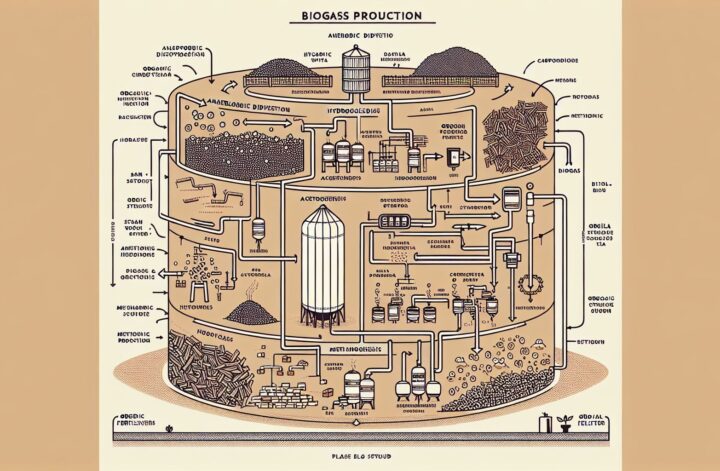
Biogas production is a key component of sustainable development, contributing to energy conservation, waste reduction, and value generation from organic waste materials. One of the fundamental techniques in biogas production is co-digestion. This process involves the digestion of multiple organic waste types in a single biogas system, which significantly enhances the efficiency and effectiveness of biogas production[^1^].
Anaerobic Digestion: A Prerequisite for Biogas Production
At the heart of biogas production is Anaerobic Digestion (AD), a process where microorganisms are used to break down biodegradable feedstocks in the absence of oxygen. The breakdown of these organic materials within the anaerobic digester leads to the production of a gaseous blend of methane (CH4) and carbon dioxide (CO2) known as biogas[^2^].
The process of anaerobic digestion takes place in four stages: the hydrolysis stage, the acidogenesis stage, the acetogenesis stage, and finally, the methanogenesis stage. These steps work in synergy, transforming the organic materials into biogas and releasing a nutrient-rich residual referred to as digestate.
The Rationale Behind Co-digestion
Co-digestion offers two main advantages. Firstly, co-digestion enables the breakdown and treatment of different types of organic waste materials simultaneously. Instead of handling organic waste types individually, they can be co-digested together, resulting in increased efficiency and the potential production of a more enriched biogas.
Secondly, co-digestion allows for the complementary use of different waste substrates. Some feedstocks possess high carbon content but low nitrogen levels and vice versa. Through co-digestion, biogas systems can use a blend of feedstocks that advantages each other’s weaknesses and enhances overall biogas production[^1^].
Co-digestion on a Larger Scale
On a larger scale, co-digestion plays a pivotal role in waste treatment and renewable energy production. Due to the efficiency attributed to co-digestion, more organic waste materials can be treated per time within a biogas system. This results in significant reduction in the total volume of waste materials, and in turn, a substantial decline in overall waste management costs.
Furthermore, co-digestion’s ability to enhance biogas production means there’s a larger reserve of renewable energy source that can be used to meet energy demands. This has implications for reducing dependency on fossil fuels and mitigating the release of greenhouse gases that contribute to climate change[^3^].
Co-digestion Challenges and Considerations
Despite the potentials offered by co-digestion, a few challenges can arise. One of the common hurdles faced in co-digestion is incompatibility issues between different feedstocks. For instance, some feedstocks may contain substances that inhibit or slow down the digestion of other feedstocks. Therefore, careful consideration and planning is required in selecting the feedstocks to co-digest[^1^].
Another challenge concerns logistic issues. The feedstocks for co-digestion will often come from different sources, and transporting these to the biogas plant can involve additional costs and efforts. To mitigate this, biogas plants can be strategically positioned to reduce transportation distance and costs[^3^].
Final Thoughts
Co-digestion offers promising potential for enhancing biogas production efficiency and significantly contributing to sustainable waste management and renewable energy production. It is therefore an area worth exploring and investing in.
The key to successful and efficient co-digestion lies in understanding the properties of different organic waste materials and selecting favorable combinations that will enhance each other’s strengths while compensating for their weaknesses. It is also crucial to factor in logistic considerations and carefully tread the line between cost-effectiveness and operational efficiency.
[^1^]: Callaghan, F. J., Wase, D. A. J., Thayanithy, K., & Forster, C. F. (2002). Co-digestion of waste organic solids: batch studies. Bioresource Technology, 83(3), 259-263.
[^2^]: Abbassi-Guendouz, A., Brockmann, D., Trably, E., Dumas, C., Delgenès, J. P., & Escudié, R. (2012). Total solids content: a key parameter of metabolic pathways in dry anaerobic digestion. Bioresource Technology, 111, 55-61.
[^3^]: Schievano, A., D’Imporzano, G., & Adani, F. (2009). Substituting energy crops with organic wastes and agro-industrial residues for biogas production. Journal of environmental management, 90(8), 2537-2541.