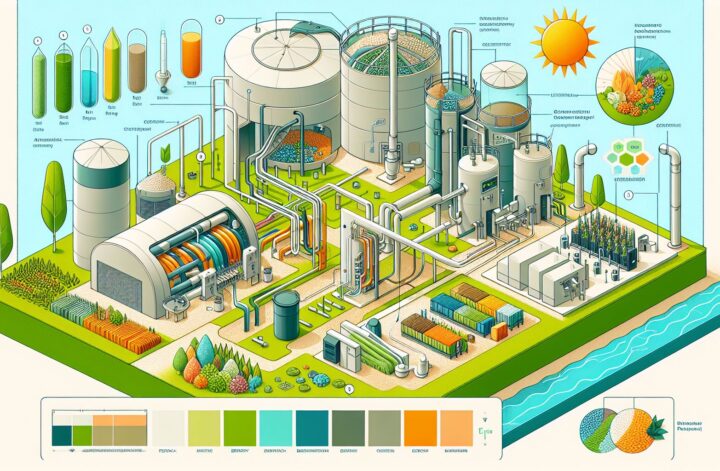
With the rapidly increasing global population, environmental pollution is becoming a significant concern. As such, waste management systems and sustainable energy solutions are in high demand. Among these, one solution stands out: Biogas production. Biogas serves as a sustainable energy source that reduces dependency on conventional energy sources and aids in organic waste management. This article explores the process of biogas production, its benefits, and its potential for reducing greenhouse gas.
What is Biogas?
Biogas is a renewable energy source, consisting primarily of methane (CH4) and carbon dioxide (CO2). It is produced by the anaerobic digestion or fermentation of organic material, including manure, sewage sludge, municipal solid waste, crop residues, and energy crops[^1^].
The Process of Biogas Production
Biogas is produced through a series of biological processes, starting with hydrolysis, followed by acidogenesis, acetogenesis, and ending with methanogenesis. During this process, complex organic molecules are broken down into simple sugars, amino acids, and fatty acids. These are then further converted to biogas[^2^].
Hydrolysis
During hydrolysis, complex organic molecules are broken down into simpler molecules by hydrolytic bacteria. Proteins turn into amino acids, carbohydrates degrade into simple sugars, and fats are converted into long-chain fatty acids and glycerol.
Acidogenesis
During acidogenesis, these simpler molecules are further broken down by acidogenic bacteria. Sugars and amino acids are turned into alcohol, organic acids, hydrogen, and carbon dioxide.
Acetogenesis
The organic acids and alcohol produced during acidogenesis are then converted into hydrogen, carbon dioxide, and acetate by acetogenesis bacteria.
Methanogenesis
Finally, during methanogenesis, methanogenesis bacteria convert the acetate, hydrogen, and carbon dioxide into methane and water. Methane is the main component of the biogas produced[^3^].
Advantages and Applications of Biogas
The advantages and applications of biogas are extensive:
- Renewable Energy Source: Since biogas is derived from organic waste, which is continually produced, it is classified as a renewable energy source.
- Organic Waste Management: The biogas production process aids in organic waste treatment, serving as an effective waste management solution.
- Energy Production: Biogas can be used to produce heat and electricity, commonly known as combined heat and power (CHP), which can be useful in numerous applications.
- Fuel: After being scrubbed and upgraded to remove impurities, biogas can be used as a fuel for vehicles.
- Fertilizer: The digested remaining after anaerobic digestion, known as digestate, can be used as a nutrient-rich, organic fertilizer[^4^].
Biogas and Greenhouse Gas Reduction
Biogas production is considered an effective method for greenhouse gas reduction. It prevents the release of methane produced during the decomposition of organic waste. When considering the global warming potential, methane is far more potent than carbon dioxide. Therefore, by capturing methane and converting it into an energy source, biogas production can help in mitigating the negative impacts of climate change[^5^].
However, the potential of biogas in greenhouse gas reduction goes beyond just capturing methane. The energy produced from biogas can replace energy derived from fossil fuels, leading to a further reduction in greenhouse gas emissions.
In conclusion, biogas production is not just about waste management or renewable energy, but it also holds immense potential for greenhouse gas reduction, contributing to a sustainable future. With the advanced technologies available today, the opportunities to harness the power of biogas are limitless.
References
[^1^]: European Biogas Association, 2021. “Biogas.” https://european-biogas.eu/biogas/.
[^2^]: Ma, J., 2017. “Methanogenesis-Aided Wastewater Treatment: Principle and Application.” Wiley Online Library: https://onlinelibrary.wiley.com/doi/10.1002/clen.201400673.
[^3^]: Deublein, D., Steinhauser, A., 2010. “Biogas from Waste and Renewable Resources.” Wiley: https://www.wiley.com/en-us/Biogas+from+Waste+and+Renewable+Resources%3A+An+Introduction%2C+2nd%2C+Revised+and+Expanded+Edition-p-9783527327980.
[^4^]: U.S. Environmental Protection Agency, 2020. “Benefits of Anaerobic Digestion and Biogas.” https://www.epa.gov/anaerobic-digestion/benefits-anaerobic-digestion-and-biogas.
[^5^]: Tabassum, M., 2012. “Effect of Biogas Utilization and the Efficiency of Biogas Plant on Global Warming Reduction.” https://www.intechopen.com/chapters/33318.